
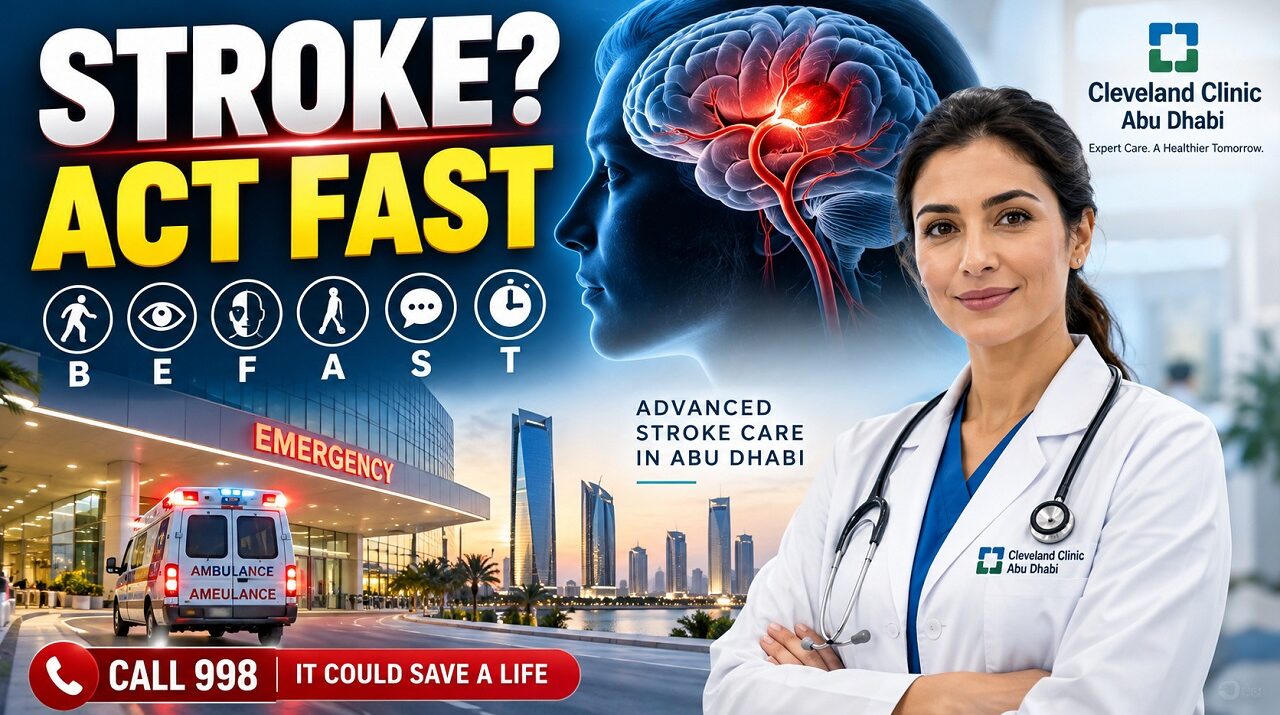
A stroke can happen without warning, and the first few minutes can affect what happens next. When blood flow to the brain is blocked or a blood vessel ruptures, brain tissue can become damaged quickly. Knowing the warning signs and understanding stroke treatment can help families respond without wasting valuable time. Cleveland Clinic Abu Dhabi explains that stroke is a medical emergency and highlights B.E. F.A.S.T. as a simple way to recognize common warning signs.
If symptoms appear, do not wait to see whether they disappear. In the UAE, call 998 for an ambulance and note when the symptoms first started.
Quick Answer: Stroke treatment depends on whether the stroke is caused by a clot or bleeding. Emergency assessment usually includes brain imaging to identify the stroke type. Ischemic strokes may be treated with clot dissolving medicine or thrombectomy in eligible patients, while hemorrhagic strokes may require blood pressure control, intensive care or surgery. Rehabilitation and prevention then become central to recovery.
What is stroke treatment?
Stroke treatment is the emergency and ongoing medical care used to limit brain injury, treat the underlying cause, prevent complications and support recovery after a stroke. Treatment differs according to whether the stroke is ischemic, caused by a blocked blood vessel, or hemorrhagic, caused by bleeding in or around the brain.
What Happens During a Stroke
A stroke occurs when the brain suddenly loses its normal blood supply or a blood vessel in the brain ruptures. The two broad categories are:
| Stroke type | What happens | Possible treatment approach |
|---|---|---|
| Ischemic stroke | A clot blocks blood flow to part of the brain | Clot dissolving treatment and/or thrombectomy for eligible patients |
| Hemorrhagic stroke | A blood vessel leaks or ruptures | Blood pressure control, specialist monitoring and sometimes surgery |
The distinction matters because treatment for one type can be inappropriate or dangerous for the other. That is why doctors need urgent brain imaging, commonly CT or MRI, before selecting treatment. WHO guidance emphasizes rapid diagnosis and time-sensitive care.
Summary: Stroke is not something to monitor at home. The cause must be identified quickly so clinicians can choose appropriate emergency treatment.
How BEFAST Helps Identify a Stroke
Cleveland Clinic Abu Dhabi uses B.E. F.A.S.T. to make stroke symptoms easier to remember.
- B — Balance: Sudden dizziness, loss of balance or coordination.
- E — Eyes: Sudden vision problems, including difficulty seeing or double vision.
- F — Face: One side of the face may droop when smiling.
- A — Arms: One arm may become weak or drift downward when both arms are raised.
- S — Speech: Speech may become slurred, confused or difficult to understand.
- T — Time: Treat the symptoms as an emergency and call for medical help immediately.
Other possible warning signs include sudden numbness or weakness, confusion, trouble walking and a severe headache with no known cause.
If you notice one or more signs, do not drive the person yourself if an ambulance is available. Emergency medical personnel can begin assessment and care while transporting the patient. Also record the time symptoms began, or the last time the person was known to be well. That information can influence treatment decisions.
How Stroke Treatment Works
Emergency stroke management begins with rapid assessment. Doctors need to determine the type of stroke, where it occurred and how severe it is.
Ischemic stroke treatment
For an ischemic stroke caused by a clot, eligible patients may receive thrombolytic therapy to dissolve the clot. Some patients with a large-vessel blockage may also be candidates for endovascular thrombectomy, a procedure used to remove the clot mechanically. Treatment eligibility depends on factors such as symptom timing, imaging findings and the patient’s clinical condition.
Hemorrhagic stroke treatment
Hemorrhagic stroke management is different. Care may involve controlling blood pressure, monitoring the patient closely and treating the source or consequences of bleeding. Some cases require neurosurgical or neuro-interventional procedures.
Summary: There is no single stroke treatment that works for everyone. Fast diagnosis determines whether clot treatment, thrombectomy, bleeding control, surgery or another approach is appropriate.
What to Do After a Stroke
Knowing what to do after a stroke is important because emergency treatment is only the beginning of care.
1. Follow the prescribed treatment plan
Depending on the cause, doctors may prescribe medicines to address blood pressure, cholesterol, blood clotting, atrial fibrillation or other stroke risk factors. Never stop or change prescribed medicines without speaking with the treating clinician. Secondary prevention is a major part of stroke management.
2. Start rehabilitation when medically appropriate
Stroke rehabilitation may include:
- Physical therapy for movement, balance and strength
- Occupational therapy for daily activities
- Speech and language therapy for communication and swallowing
- Cognitive rehabilitation where appropriate
- Psychological support for emotional and mental health needs
The 2026 American Heart Association/American Stroke Association rehabilitation guideline recommends starting rehabilitation during the acute phase once the person is medically stable, with individualized goals and multidisciplinary support.
3. Watch for swallowing problems
Difficulty swallowing can occur after stroke and may increase the risk of aspiration. Do not change food texture, thicken liquids or crush medicines unless the healthcare team has advised that it is safe. Online stroke communities frequently highlight swallowing and medication difficulties as practical challenges after discharge, but these experiences should complement—not replace—professional assessment.
4. Support prevention
Long-term stroke management may involve controlling high blood pressure, diabetes, cholesterol and heart rhythm problems, along with stopping tobacco use, maintaining appropriate physical activity and following a balanced diet.
Stroke Management and Rehabilitation
Recovery varies considerably. Some people regain independence quickly, while others need support for months or longer. Recovery can involve physical, communication, cognitive and emotional changes, and progress does not always happen at the same speed.
The latest rehabilitation guidance emphasizes continued assessment rather than treating discharge from therapy as the end of recovery. Rehabilitation goals may need to change as the person’s abilities change.
For families, practical organization can make daily care easier:
- Keep an up-to-date medication list.
- Record appointments and therapy sessions.
- Follow swallowing and dietary instructions carefully.
- Keep emergency contact information accessible.
- Ask the rehabilitation team what exercises are safe at home.
- Report new or worsening neurological symptoms immediately.
Summary: Recovery is a process rather than a single event. Medication adherence, rehabilitation, risk-factor control and coordinated follow-up all have a role in long-term stroke care.
Common Mistakes to Avoid
Some seemingly harmless responses can delay appropriate care.
Waiting for symptoms to disappear
Stroke symptoms can fluctuate, but temporary improvement does not make them safe to ignore. A transient ischemic attack can also be a warning of future stroke risk.
Giving food or drink during suspected stroke
If a person has impaired swallowing or consciousness, giving food, water or medication by mouth may be unsafe. Wait for medical assessment.
Changing medicines independently
A survivor may have several medicines after a stroke. Stopping one because the person feels better, or changing a dose without medical advice, can interfere with prevention.
Assuming recovery has a fixed deadline
Stroke recovery differs from person to person. Current rehabilitation guidance supports ongoing reassessment and continued therapy when appropriate rather than assuming improvement must stop after a particular period.
Stroke Care in Abu Dhabi
People looking for stroke care Abu Dhabi need access to emergency assessment as well as specialist follow-up and rehabilitation.
Cleveland Clinic Abu Dhabi’s Neurovascular Medicine Program and Stroke Center provides emergency stroke management, advanced diagnostic assessment, neuro-interventional procedures, neurosurgical care and rehabilitation. The hospital states that it is designated by the Department of Health as an official Stroke Center for the Emirate of Abu Dhabi and has Comprehensive Stroke Center Certification from the American Stroke Association.
The hospital’s Emergency Department operates 24/7.
For anyone currently showing possible stroke symptoms in the UAE, call 998 for an ambulance rather than waiting for an outpatient appointment.
People Also Ask
What are the first signs of a stroke?
Sudden balance problems, vision changes, facial drooping, arm weakness and speech difficulties are key warning signs remembered by B.E. F.A.S.T. Sudden severe headache, confusion, numbness or difficulty walking can also occur. If these symptoms appear, treat them as an emergency and seek immediate medical help.
How quickly should stroke treatment begin?
As quickly as possible. Stroke treatment is time-sensitive, and some therapies are only suitable within specific time windows. The exact treatment window depends on the stroke type, symptom timing and imaging results. This is why noting when symptoms started—or the last known well time—is important.
What happens after a stroke?
After emergency treatment, patients may need medication, monitoring, rehabilitation and follow-up care. Rehabilitation can address movement, speech, swallowing, daily activities, cognition and emotional health. Recovery differs widely between individuals and can continue over an extended period.
Can someone recover fully from a stroke?
Some people recover very well, while others have lasting impairments. Recovery depends on factors including the type and severity of stroke, affected brain areas, complications and access to rehabilitation. It is not possible to predict an individual’s outcome from the stroke diagnosis alone.
FAQ
Is stroke treatment different for ischemic and hemorrhagic stroke?
Yes. Ischemic stroke is caused by an obstruction of blood flow, while hemorrhagic stroke involves bleeding. Because the causes are different, emergency treatment is different too. Ischemic stroke may be treated with thrombolytic medication and, in selected cases, mechanical thrombectomy. Hemorrhagic stroke management can include blood pressure control, specialist monitoring and procedures or surgery when necessary. Brain imaging is essential to determine which type of stroke has occurred.
What should family members do after a stroke?
Family members can help by following the medical team’s instructions, organizing medicines and appointments, supporting prescribed rehabilitation exercises and watching for changes in swallowing, mobility, communication or neurological symptoms. Caregivers should also receive clear training before taking responsibility for complex home care. Current stroke rehabilitation guidance emphasizes education and support for care partners as part of coordinated recovery.
How long does stroke recovery take?
There is no universal recovery timeline. Some improvements may happen early, while other physical, language or cognitive gains can continue over months or longer. The latest American Heart Association/American Stroke Association guidance recommends periodic reassessment and renewed therapy when new needs or functional decline emerge.
When should someone seek emergency help after a previous stroke?
Any new sudden neurological symptom—including facial drooping, new weakness, speech difficulty, sudden vision change or loss of balance—should be treated as a potential new stroke or other emergency. Do not assume a new symptom is part of the previous stroke. In the UAE, call 998 for an ambulance.
Stroke care starts with recognizing an emergency and acting without delay. BEFAST provides a practical way to remember the major warning signs, while urgent brain imaging helps clinicians distinguish ischemic from hemorrhagic stroke and select appropriate treatment. After the emergency phase, effective stroke management continues through medication, rehabilitation, risk-factor control and coordinated follow-up.
For patients and families, the most useful approach is simple: know the warning signs, record the time symptoms begin, seek emergency care immediately and follow the rehabilitation plan closely. Recovery can look different for every person, so ongoing medical assessment matters.
Key Takeaways
- Stroke is a medical emergency.
- Remember B.E. F.A.S.T. for common warning signs.
- Call 998 for an ambulance in the UAE when stroke is suspected.
- Brain imaging helps determine the appropriate treatment.
- Ischemic and hemorrhagic strokes require different management.
- Rehabilitation can address movement, speech, swallowing, cognition and daily activities.
- Blood pressure, cholesterol, diabetes and heart conditions should be managed to reduce future risk.
- New neurological symptoms after a previous stroke require urgent assessment.
Cleveland Clinic Abu Dhabi
Cleveland Clinic Abu Dhabi provides specialist neurological and stroke services covering emergency assessment, advanced diagnostics, neurovascular intervention, neurosurgical care and rehabilitation. Its Neurovascular Medicine Program and Stroke Center describes a coordinated approach from emergency stroke management through outpatient follow-up and rehabilitation.
للحصول على رعاية متخصصة للسكتة الدماغية في أبوظبي، يوفر مستشفى كليفلاند كلينك أبوظبي خدمات طبية متقدمة تشمل تقييم حالات السكتة الدماغية بشكل طارئ، والتشخيص المتقدم، والعلاجات التداخلية، وجراحة الأعصاب وإعادة التأهيل، مع خدمات باللغتين العربية والإنجليزية. للمعلومات والمواعيد، يمكن التواصل على الرقم 800 8 2223. يقع المستشفى في جزيرة المارية، أبوظبي، الإمارات العربية المتحدة. الموقع الإلكتروني لكليفلاند كلينك أبوظبي